Friday, August 29, 2008

Photos


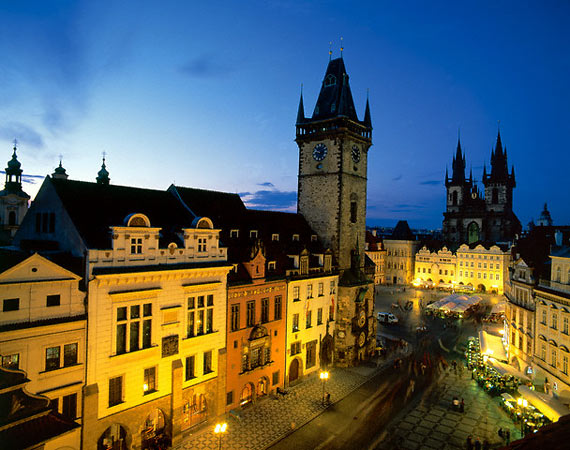
Czech Republic information


Location: Central Europe, bordering Austria 362 km, Germany 646 km, Poland 658 km, Slovakia 215 km

Capital: Prague

Population: 10,246,178 (July 2004 est.)

Ethnic Make-up: Czech 81.2%, Moravian 13.2%, Slovak 3.1%, Polish 0.6%, German 0.5%, Silesian 0.4%, Roma 0.3%, Hungarian 0.2%, other 0.5% (1991)

Religions: Roman Catholic 39.2%, Protestant 4.6%, Orthodox 3%, other 13.4%, atheist 39.8%


The Czech Language

95% of the population speak Czech. 3% of the population speak Slovak, which is closely related to Czech. 2% of the population speak Czech but are also mother tongue speakers of German, Hungarian, Romani and Polish.

Czech Society & Culture

The Family

. The family is the centre of the social structure.
. Obligation to the family is a person's first priority.
Practicality
. Czechs prize forward thinking, logical, practical, and efficient.
. Careful planning, in both one's business and personal life, provides a sense of security.
. Rules and regulations allow people to know what is expected and to plan their life accordingly.

Privacy

. Czechs are private people until they get to know you.
. They are formal and reserved.
. Once you develop a personal relationship Czechs open up a bit, but they are never overly emotional.
. Although always polite, they seldom move to a first-name basis with people outside their extended family or very close friends.
. Czechs tend not to acknowledge people whom they do not know as they walk along the street or ride the train.

Czech Etiquette and Customs

Meeting and Greeting

. Initial greetings are formal and reserved.
. Most greetings include a handshake, direct eye contact, and the appropriate greeting for the time of day.
. Wait to be invited before using someone's first name or an informal greeting, as these are all signs of friendship.
. The offer to move to the informal is generally offered by the woman, the older person, or the person of higher status.
. Moving to the informal without an invitation insults the person and may be viewed as an attempt to humiliate them.

Giving and Accepting Gifts

. If you are invited to dinner, bring a box of good quality chocolates, or flowers to the hostess or a bottle of wine or good brandy to the host.
. In general, you should be cautious about giving flowers, since people over the age of 35 often see flowers as having a romantic connotation.
. If you give flowers, give an odd number, but not 13, which is considered unlucky.
. Do not give calla lilies as they are used at funerals.
. Gifts are usually opened when received.

Dining Etiquette

If you are visiting a Czech's house:
. Arrive on time.
. Remove your shoes..
. Expect to be treated with great honour and respect.
. Dress modestly and well.
. Do not discuss business. Czechs separate their business and personal lives.
. Table manners are rather formal in Czech Republic.
. Remain standing until invited to sit down. You may be shown to a particular seat.
. Table manners are Continental -- the fork is held in the left hand and the knife in the right while eating.
. Do not begin eating until the hostess starts.
. Unless the meal is formal, the napkin remains folded next to the plate. At formal meals, the napkin is unfolded and put on your lap.
. The oldest woman or honoured guest is generally served first.
. Always refuse second helpings the first time they are offered. Wait for the hostess to insist.
. Compliment the meal while you are eating. This allows the hostess to discuss the food and the preparation.
. Indicate you have finished eating by laying your knife and fork parallel across the right side of your plate.

Business Etiquette and Protocol


Business Meetings

. Appointments are mandatory and should be made in advance.
. Letters should be addressed to the company rather than a specific person. This prevents a letter from being held up if the person it is addressed to is away from the office.
. Do not try to schedule meetings on Friday afternoon as many Czechs leave for their country cottages after lunch.
. Many businesses close during August.
. Punctuality for meetings is taken extremely seriously.
. Initial meetings are scheduled to get to know each other and to see if your Czech associates believe that you are trustworthy. The first meeting may be with a gatekeeper rather than the actual decision maker.
. Expect some small talk and getting-to-know-you conversation before business is discussed.
. Maintain direct eye contact while speaking.
. Do not remove your suit jacket unless the highest-ranking Czech does so.
. Presentations should be accurate, detailed and thorough.
. Have charts and figures to back up your claims.

Communication

. Czechs are both formal and somewhat indirect in their communication.
. They try not to purposely offend and will often go out of their way to protect someone's feelings.
. Czechs are non-confrontational and often take an indirect approach to business dealings.
. If they lower their eyes and become silent they are uncomfortable with something you have said.

Negotiating

. It will take several meetings for your Czech business associates to become familiar with you and appear comfortable and friendly. . Politeness prevents many Czechs from giving an absolute 'no'. However, statements such as 'It is difficult' or 'We will see' are often negatives.
. Business is conducted slowly. You will have to be patient and not appear ruffled by the strict adherence to protocol.
. Business is hierarchical. Decision-making power is held at the top of the company. Decisions are reached slowly.
. It may take several visits to reach a decision.
. Avoid high-pressure tactics.
. Czechs generally offer what they expect to get and do not often give counter-offers.

Links and Information about the Czech Republic

* Currency - the currency of the Czech Republic is the Koruna. Use the free currency converter to compare to dollars, GBP or Euro.

* Weather - visit Yahoo!'s up to date Weather for the Czech Republic.

* Translation Services - do you need a Czech translation service?

* News - check out all the latest Google news on the Czech Republic.

* Intercultural Know-how - use the Intercultural Business Communication tool or read doing business in Czech Republic.

* Dialling Code - the international dialling code is +420.

* Time - The Republic is +1 hours GMT. Get the time in Prague now.

* History - read about the long and rich Czech history.

* Hotels - for accomodation see Hotels in Czech Republic

Photos of China


China Information


Location: Eastern Asia bordering Afghanistan 76 km, Bhutan 470 km, Burma 2,185 km, India 3,380 km, Kazakhstan 1,533 km, North Korea 1,416 km, Kyrgyzstan 858 km, Laos 423 km, Mongolia 4,677 km, Nepal 1,236 km, Pakistan 523 km, Russia (northeast) 3,605 km, Russia (northwest) 40 km, Tajikistan 414 km, Vietnam 1,281 km

Capital: Beijing

Climate: extremely diverse; tropical in south to subarctic in north

Population: 1,298,847,624 (July 2004 est.)

Ethnic Make-up: Han Chinese 91.9%, Zhuang, Uygur, Hui, Yi, Tibetan, Miao, Manchu, Mongol, Buyi, Korean, and other nationalities 8.1%

Religions: Daoist (Taoist), Buddhist, Muslim 1%-2%, Christian 3%-4%

Government: Communist state

The Chinese Language

Chinese is a family of closely-related but mutually unintelligible languages. These languages are known variously as f¨¡ngy¨¢n (regional languages), dialects of Chinese or varieties of Chinese. In all over 1.2 billion people speak one or more varieties of Chinese.
All varieties of Chinese belong to the Sino-Tibetan family of languages and each one has its own dialects and sub-dialects, which are more or less mutually intelligible.

Why not learn some useful Manadarin or Cantonese phrases before your visit?

Chinese Society & Culture

The Importance of "Face"

. The concept of 'face' roughly translates as 'honour', 'good reputation' or 'respect'.
. There are four types of 'face':
1) Diu-mian-zi: this is when one's actions or deeds have been exposed to people.
2) Gei-mian-zi: involves the giving of face to others through showing respect.
3) Liu-mian-zi: this is developed by avoiding mistakes and showing wisdom in action.
4) Jiang-mian-zi: this is when face is increased through others, i.e. someone complementing you to an associate.
. It is critical you avoid losing face or causing the loss of face at all times.

Confucianism

Confucianism is a system of behaviours and ethics that stress the obligations of people towards one another based upon their relationship. The basic tenets are based upon five different relationships:

. Ruler and subject
. Husband and wife
. Parents and children
. Brothers and sisters
. Friend and friend

Confucianism stresses duty, sincerity, loyalty, honour, filial piety, respect for age and seniority. Through maintaing harmonious relations as individuals, society itself becomes stable.

Collectivism vs. Individualism

. In general, the Chinese are a collective society with a need for group affiliation, whether to their family, school, work group, or country.
. In order to maintain a sense of harmony, they will act with decorum at all times and will not do anything to cause someone else public embarrassment.
. They are willing to subjugate their own feelings for the good of the group.
. This is often observed by the use of silence in very structured meetings. If someone disagrees with what another person says, rather than disagree publicly, the person will remain quiet. This gives face to the other person, while speaking up would make both parties lose face.

Non-Verbal Communication

. The Chinese' Non-verbal communication speaks volumes.
. Since the Chinese strive for harmony and are group dependent, they rely on facial expression, tone of voice and posture to tell them what someone feels.
. Frowning while someone is speaking is interpreted as a sign of disagreement. Therefore, most Chinese maintain an impassive expression when speaking.
. It is considered disrespectful to stare into another person's eyes. In crowded situations the Chinese avoid eye contact to give themselves privacy.


Meeting Etiquette

. Greetings are formal and the oldest person is always greeted first.
. Handshakes are the most common form of greeting with foreigners.
. Many Chinese will look towards the ground when greeting someone.
. Address the person by an honorific title and their surname. If they want to move to a first-name basis, they will advise you which name to use.
. The Chinese have a terrific sense of humour. They can laugh at themselves most readily if they have a comfortable relationship with the other person. Be ready to laugh at yourself given the proper circumstances.

Gift Giving Etiquette

. In general, gifts are given at Chinese New Year, weddings, births and more recently (because of marketing), birthdays.
. The Chinese like food and a nice food basket will make a great gift.
. Do not give scissors, knives or other cutting utensils as they indicate the severing of the relationship.
. Do not give clocks, handkerchiefs or straw sandals as they are associated with funerals and death.
. Do not give flowers, as many Chinese associate these with funerals.
. Do not wrap gifts in white, blue or black paper.
. Four is an unlucky number so do not give four of anything. Eight is the luckiest number, so giving eight of something brings luck to the recipient.
. Always present gifts with two hands.
. Gifts are not opened when received.
. Gifts may be refused three times before they are accepted.

Dining Etiquette

. The Chinese prefer to entertain in public places rather than in their homes, especially when entertaining foreigners.
. If you are invited to their house, consider it a great honour. If you must turn down such an honour, it is considered polite to explain the conflict in your schedule so that your actions are not taken as a slight.
. Arrive on time.
. Remove your shoes before entering the house.
. Bring a small gift to the hostess.
. Eat well to demonstrate that you are enjoying the food!
Table manners:
. Learn to use chopsticks.
. Wait to be told where to sit. The guest of honour will be given a seat facing the door.
. The host begins eating first.
. You should try everything that is offered to you.
. Never eat the last piece from the serving tray.
. Be observant to other peoples' needs.
. Chopsticks should be returned to the chopstick rest after every few bites and when you drink or stop to speak.
. The host offers the first toast.
. Do not put bones in your bowl. Place them on the table or in a special bowl for that purpose.
. Hold the rice bowl close to your mouth while eating.
. Do not be offended if a Chinese person makes slurping or belching sounds; it merely indicates that they are enjoying their food.
. There are no strict rules about finishing all the food in your bowl.

Tipping Etiquette: Tipping is becoming more commonplace, especially with younger workers although older workers still consider it an insult. Leaving a few coins is usually sufficient.


Relationships & Communication

. The Chinese don't like doing business with companies they don't know, so working through an intermediary is crucial. This could be an individual or an organization who can make a formal introduction and vouch for the reliability of your company.
. Before arriving in China send materials (written in Chinese) that describe your company, its history, and literature about your products and services. The Chinese often use intermediaries to ask questions that they would prefer not to make directly.
. Business relationships are built formally after the Chinese get to know you.
. Be very patient. It takes a considerable amount of time and is bound up with enormous bureaucracy.
. The Chinese see foreigners as representatives of their company rather than as individuals.
. Rank is extremely important in business relationships and you must keep rank differences in mind when communicating.
. Gender bias is nonexistent in business.
. Never lose sight of the fact that communication is official, especially in dealing with someone of higher rank. Treating them too informally, especially in front of their peers, may well ruin a potential deal.
. The Chinese prefer face-to-face meetings rather than written or telephonic communication.
. Meals and social events are not the place for business discussions. There is a demarcation between business and socializing in China, so try to be careful not to intertwine the two.

Business Meeting Etiquette

. Appointments are necessary and, if possible, should be made between one-to-two months in advance, preferably in writing.
. If you do not have a contact within the company, use an intermediary to arrange a formal introduction. Once the introduction has been made, you should provide the company with information about your company and what you want to accomplish at the meeting.
. You should arrive at meetings on time or slightly early. The Chinese view punctuality as a virtue. Arriving late is an insult and could negatively affect your relationship
. Pay great attention to the agenda as each Chinese participant has his or her own agenda that they will attempt to introduce.
. Send an agenda before the meeting so your Chinese colleagues have the chance to meet with any technical experts prior to the meeting. Discuss the agenda with your translator/intermediary prior to submission.
. Each participant will take an opportunity to dominate the floor for lengthy periods without appearing to say very much of anything that actually contributes to the meeting. Be patient and listen. There could be subtle messages being transmitted that would assist you in allaying fears of on-going association.
. Meetings require patience. Mobile phones ring frequently and conversations tend to be boisterous. Never ask the Chinese to turn off their mobile phones as this causes you both to lose face.
. Guests are generally escorted to their seats, which are in descending order of rank. Senior people generally sit opposite senior people from the other side.
. It is imperative that you bring your own interpreter, especially if you plan to discuss legal or extremely technical concepts as you can brief the interpreter prior to the meeting.
. Written material should be available in both English and Chinese, using simplified characters. Be very careful about what is written. Make absolutely certain that written translations are accurate and cannot be misinterpreted.
. Visual aids are useful in large meetings and should only be done with black type on white background. Colours have special meanings and if you are not careful, your colour choice could work against you.
. Presentations should be detailed and factual and focus on long-term benefits. Be prepared for the presentation to be a challenge.

Business Negotiation

. Only senior members of the negotiating team will speak. Designate the most senior person in your group as your spokesman for the introductory functions.
. Business negotiations occur at a slow pace.
. Be prepared for the agenda to become a jumping off point for other discussions.
. Chinese are non-confrontational. They will not overtly say 'no', they will say 'they will think about it' or 'they will see'.
. Chinese negotiations are process oriented. They want to determine if relationships can develop to a stage where both parties are comfortable doing business with the other.
. Decisions may take a long time, as they require careful review and consideration.
. Under no circumstances should you lose your temper or you will lose face and irrevocably damage your relationship.
. Do not use high-pressure tactics. You might find yourself outmanoeuvred.
. Business is hierarchical. Decisions are unlikely to be made during the meetings you attend.
. The Chinese are shrewd negotiators.
. Your starting price should leave room for negotiation.

What to Wear?

. Business attire is conservative and unpretentious.
. Men should wear dark coloured, conservative business suits.
. Women should wear conservative business suits or dresses with a high neckline.
. Women should wear flat shoes or shoes with very low heels.
. Bright colours should be avoided.

Business Cards

. Business cards are exchanged after the initial introduction.
. Have one side of your business card translated into Chinese using simplified Chinese characters that are printed in gold ink since gold is an auspicious colour.
. Your business card should include your title. If your company is the oldest or largest in your country, that fact should be on your card as well.
. Hold the card in both hands when offering it, Chinese side facing the recipient.
. Examine a business card before putting it on the table next to you or in a business card case.
. Never write on someone's card unless so directed.

Links and Information about China

* Currency - the currency of China is the Yuan. Use the free currency converter to compare to dollars, GBP or Euro.

* Weather - visit Yahoo!'s up to date Weather for China.

* Translation Services - do you need a Chinese translation service?

* News - check out all the latest Google news on China.

* Intercultural Know-how - use the Intercultural Business Communication tool or read doing business in China.

* Dialling Code - the international dialling code for China is +86.

* Time - China is +8 hours GMT. Get the time in China now.

* History - read about the long and rich history of China.

* Quiz - test your knowledge of Chinese etiquette and culture with the Doing Business in China Quiz!

* Hotels - for accomodation see Hotels in China.
Photos of Egypt


Egypt information


Facts and Statistics

Location: North East Africa bordering Palestine (Gaza Strip) 11 km, Israel 266 km, Libya
1,115 km, Sudan 1,273 km

Capital: Cairo

Climate: desert; hot, dry summers with moderate winters

Population: 76,117,421 (July 2004 est.)

Ethnic Make-up: Eastern Hamitic stock (Egyptians, Bedouins, and Berbers) 99%, Greek, Nubian,
Armenian, other European (primarily Italian and French) 1%

Religions: Muslim (mostly Sunni) 94%, Coptic Christian and other 6%

Government: republic

Language in Egypt

For almost 13 centuries Arabic has been the written and spoken language of Egypt. Before the Arab invasion in AD 639, Coptic, the language descended from ancient Egyptian, was the language of both religious and everyday life for the mass of the population; by the 12th century, however, it had been totally replaced by Arabic, continuing only as a liturgical language for the Coptic Orthodox Church. Arabic has become the language of both the Egyptian Christian and Muslim. The written form of the Arabic language, in grammar and syntax, has remained substantially unchanged since the 7th century. In other ways, however, the written language has changed the modern forms of style, word sequence, and phraseology are simpler and more flexible than in classical Arabic and are often directly derivative of English or French.

Why not learn some useful Arabic phrases?

Egyptian Society & Culture

Islam

Islam is practised by the majority of Egyptians and governs their personal, political, economic and legal lives. Islam emanated from what is today Saudi Arabia. The Prophet Muhammad is seen as the last of God's emissaries (following in the footsteps of Jesus, Moses, Abraham, etc) to bring revelation to mankind. He was distinguished with bringing a message for the whole of mankind, rather than just to a certain peoples. As Moses brought the Torah and Jesus the Bible, Muhammad brought the last book, the Quran. The Quran and the actions of the Prophet (the Sunnah) are used as the basis for all guidance in the religion.

Among certain obligations for Muslims are to pray five times a day - at dawn, noon, afternoon, sunset, and evening. The exact time is listed in the local newspaper each day. Friday is the Muslim holy day. Everything is closed. Many companies also close on Thursday, making the weekend Thursday and Friday.

During the holy month of Ramadan all Muslims must fast from dawn to dusk and are only permitted to work six hours per day. Fasting includes no eating, drinking, cigarette smoking, or gum chewing. Expatriates are not required to fast; however, they must not eat, drink, smoke, or chew gum in public.

Each night at sunset, families and friends gather together to celebrate the breaking of the fast (iftar). The festivities often continue well into the night. In general, things happen more slowly during Ramadan. Many businesses operate on a reduced schedule. Shops may be open and closed at unusual times.

Family Values

. The family is the most significant unit of Egyptian society.
. Kinship plays an important role in all social relations.
. The individual is always subordinate to the family, tribe or group.
. Nepotism is viewed positively, since it is patronage of one's family.
. The family consists of both the nuclear and the extended family.

Egyptian Honour

. Honour is an important facet of interpersonal relationships.
. Respect and esteem for people is both a right and an obligation.
. An individual's honour is intricately entwined with the reputation and honour of everyone in their family.
. Honour requires that Egyptians demonstrate hospitality to friends and guests.
. It also dictates that people dress as well as their financial circumstances allow, and show proper respect and deference to their elders and those in authority.
. A man's word is considered his bond and to go back on your word is to bring dishonour to your family.

Social Class

. Social class is very apparent in Egypt since it determines your access to power and position.
. The social class an Egyptian is born into dictates their everyday life and the opportunities they will have.
. There are three social classes: upper, middle, and lower.
. Status is defined more by family background than by absolute wealth.
. There is little social mobility.


Meeting Etiquette

. Greetings are based on both class and the religion of the person.
. It is best to follow the lead of the Egyptian you are meeting.
. Handshakes are the customary greeting among individuals of the same sex.
. Handshakes are somewhat limp and prolonged, although they are always given with a hearty smile and direct eye contact.
. Once a relationship has developed, it is common to kiss on one cheek and then the other while shaking hands, men with men and women with women.
. In any greeting between men and women, the woman must extend her hand first. If she does not, a man should bow his head in greeting.

Gift Giving Etiquette

. If you are invited to an Egyptian's home for dinner, bring good quality chocolates, sweets or pastries to the hostess.
. Do not give flowers, which are usually reserved for weddings or the ill, unless you know that the hosts would appreciate them.
. A small gift for the children shows affection.
. Always give gifts with the right hand or both hands if the gift is heavy.
. Gifts are not opened when received

Dining Etiquette

If you are invited into an Egyptian's house:
. You would normally remove your shoes before entering.
. Dress well and conservatively. Appearances are important to Egyptians.
. Compliment the host on the house.

Table manners

. Wait for the host or hostess to tell you where to sit.
. Eat with the right hand only.
. It is considered a sincere compliment to take second helpings.
. Always show appreciation for the meal.
. Salting your food is considered an insult.
. Leave a small amount of food on your plate when you have finished eating. Otherwise they will keep filling it up for you!


Relationships & Communication

. Egyptians prefer to do business with those they know and respect, therefore expect to spend time cultivating a personal relationship before business is conducted.
. Who you know is more important than what you know, so it is important to network and cultivate a number of contracts.
. Expect to be offered coffee or tea whenever you meet someone, as this demonstrates hospitality. Even if you do not take a sip, always accept the beverage. Declining the offer is viewed as rejecting the person.
. Since Egyptians judge people on appearances wear good quality conservative clothes and present yourself well at all times.
. Egyptians believe direct eye contact is a sign of honesty and sincerity, so be prepared for disconcertingly intense stares.
. Egyptians are emotive and use hand gestures when they are excited. In general, they speak softly, although they may also shout or pound the table. This is not indicative of anger; it is merely an attempt to demonstrate a point.
. You should demonstrate deference to the most senior person in the group, who will also be their spokesperson. This is a country where hierarchy and rank are very important.

Business Meeting Etiquette

. Appointments are necessary and should be made in advance.
. Confirm the meeting one week in advance, either in writing or by telephone.
. Reconfirm again a day or two before the meeting.
. Meetings are generally not private unless there is a need to discuss matters confidentially. In general, Egyptians have an open-door policy, even when they are in a meeting. This means you may experience frequent interruptions. Others may even wander into the room and start a different discussion. You may join in, but do not try to bring the topic back to the original discussion until the new person leaves.
. High- level government officials often adhere to more western business practices and hold private meetings without interruptions
. Business meetings generally start after prolonged inquiries about health, family, etc.
. If you send an agenda and presentation materials in advance of the meeting, send both an English and Egyptian Arabic translation.

Business Negotiation

. The social side of business is very important. Egyptians must know and like you to conduct business. Personal relationships are necessary for long-term business.
. Business is hierarchical. The highest ranking person makes decisions, after obtaining group consensus.
. Decisions are reached after great deliberation.
. If the government is involved, discussions will take even longer since approval must often be given by the ministers of several departments.
. Business moves at a slow pace. The society is extremely bureaucratic. It may take several visits to accomplish a simple task.
. It is advisable to include older people with impressive titles in your team since Egyptians respect age and experience.
. Expect a fair amount of haggling. Egyptians seldom see an offer as final.
. Egyptians do not like confrontation and abhor saying 'no'. If they do not respond, it usually is a negative sign.
. Always include research and documentation to support your claims.
. Do not use high-pressure tactics.
. Egyptians are tough negotiators.

Dress Etiquette

. Business attire is formal and conservative. Dress well if you want to make a good impression.
. Men should wear dark coloured, lightweight, conservative business suits, at least to the first meeting.
. Men should avoid wearing visible jewellery, especially around the face and neck.
. Women must be careful to cover themselves appropriately. Skirts and dresses should cover the knee and sleeves should cover most of the arm.

Business Cards

. Business cards are given without formal ritual.
. Have one side of your card translated into Egyptian Arabic.
. Always hand the card so the recipient may read it.
. Make a point of studying any business card you receive before putting into your business card case.